
22 October 2024
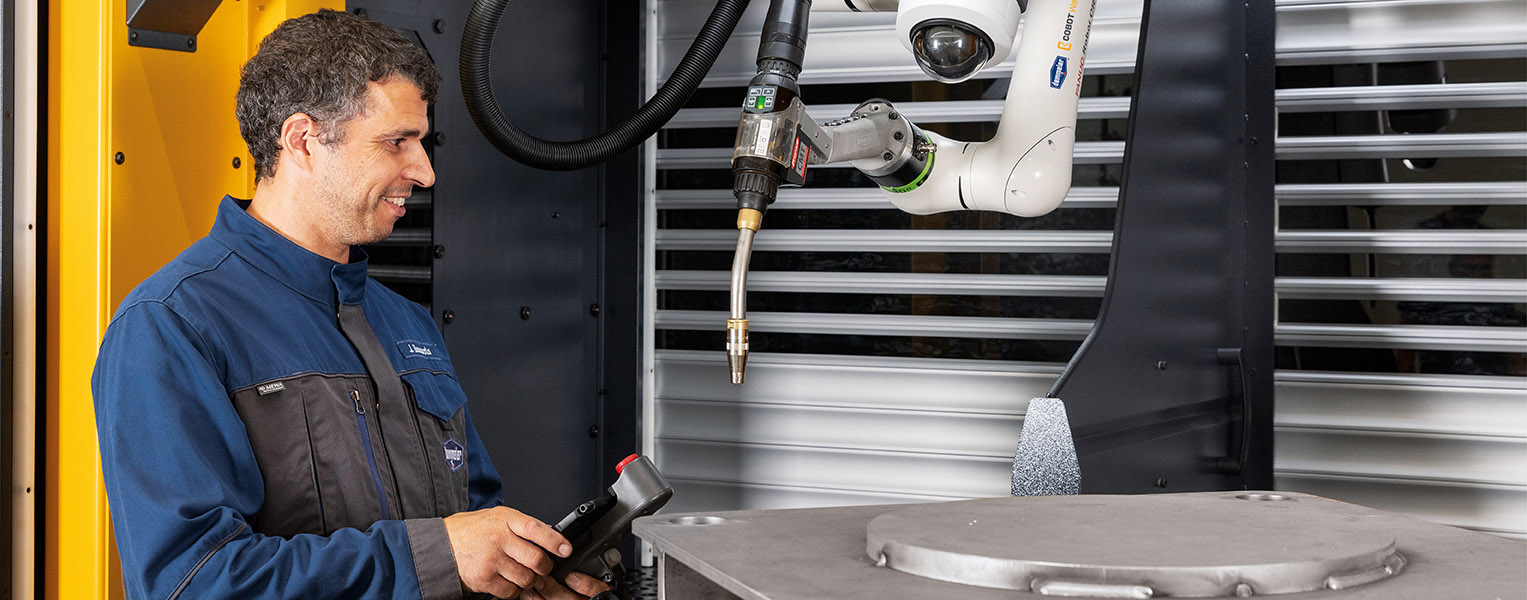
Collaborative welding robots help to counteract the shortage of skilled workers and are suitable for small and medium-sized enterprises as well as large companies. The COBOT WeldSpace 4.0 TABLE 24/12 from DEMMELER ensures high welding quality with its high flexibility, intuitive operation and intelligent features – even with tolerances and heat distortion.
In future, advances in digitalisation and automation will also change processes in welding production. Quality requirements and documentation obligations for welding work are constantly increasing. At the same time, aspects such as efficiency, safety standards and environmental protection are becoming increasingly important. If companies find it increasingly difficult to meet these requirements using manual welding, welding robots are a suitable addition. Although there are industrial robots that can perform welding tasks, they require both high investment costs and extensive programming skills. This makes them oversized for the production of small batch sizes or for use in small and medium-sized enterprises. Welding cobots are considerably easier to program than conventional industrial robots. Due to the lower investment costs, they also pay for themselves quickly.
Especially when it comes to manual welding of classic sheet metal components, the new technology of welding with collaborative robots can relieve skilled workers of tedious routine and repetitive tasks. Qualified workers can thus be optimally deployed for other value-adding activities such as quality control and reworking. Robot technology also makes the welding profession much more attractive. Young recruits in particular are becoming more enthusiastic about welding work again.
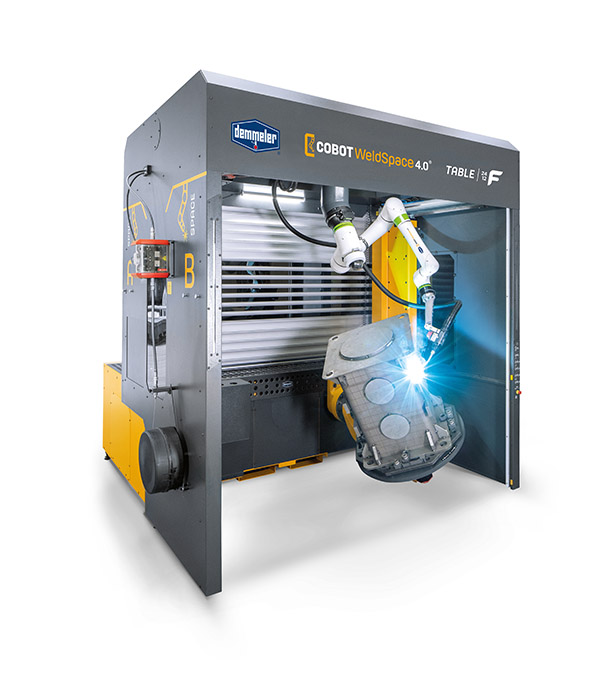
With the COBOT Weld Space 4.0 Table 24/12, DEMMELER offers a versatile automation solution with a collaborative robot.
Easy handling of collaborative robots
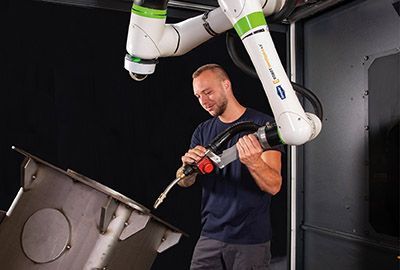
"Companies with little or no experience with robots are usually interested in a welding cobot," explains Johannes Demmeler, managing partner at DEMMELER. The DEMMELER Group, known as the inventor of 3D welding tables and clamping systems, offers a versatile automation solution with collaborative robots in the form of the COBOT WeldSpace 4.0 TABLE 24/12. The welding cell impresses with its ease of use: The software was developed in-house by DEMMELER welding experts and is perfectly tailored to the respective robot and welding process. The multifunctional handle serves as an interface between the robot and the operator. During the "teaching" process, the torch on the robot arm is manually moved to the corresponding points where welding is to take place. The start and end points as well as intermediate waypoints are saved at the touch of a button on the handle. For the welding parameters, more than 100 predefined and optimised welding jobs from a protected job library are available from DEMMELER, tailored to the material, power source and welding process. The welding process can now be simulated before the actual welding takes place. The robot arm follows the programmed weld seam and the operator can correct the path if necessary.
Smart technology for high welding quality even with tolerances and heat distortion
Thanks to the intelligent TouchSense and arc sensor features, workpieces that were previously unsuitable for automated welding due to tolerances and heat distortion can now be welded. The new TouchSense function compensates for positional shifts in the workpiece: before starting the welding programme, the cobot gently touches the component with the welding wire at four search points and scans its actual position. Any deviations are automatically calculated and the welding programme is adjusted to the actual coordinates of the component. When subsequently welding the fillet weld, the torch now moves intelligently along the ideal weld position, even if the position of the workpiece is slightly offset. This naturally reduces welding errors and time-consuming rework.
The arc sensor, in turn, compensates for bending and component tolerances during arc welding. The current feedback signal and the pendulum movement are used to track the weld seam: the torch welds along the seam with pendulum movements and reacts to changed parameters. The arc sensor therefore intervenes during the welding process to automatically correct the seam path. The result: perfect seam positioning and excellent weld quality. Clamping and component tolerances are therefore no longer an obstacle in automated welding, and the intelligent features lead to considerable savings potential, especially in series production.
The F version uses the CRX-10iA robot and FANUC's familiar drag-and-drop technology. With the professional welding software DEMMELER WeldSoft F 1.0, the system offers numerous features for industrial welding, such as automatic TCP compensation by approaching the reference tip. The main control panel provides an overview of the status of the various work areas and which one is currently active, including a practical display of the running time. The 3D overview simulates the robot and manipulator movements of the programme without the robot actually having to perform the movements. Thanks to offline programming, the teach pendant can be simulated on the PC and the robot can also be programmed independently of operation. Non-productive times are reduced to an absolute minimum.
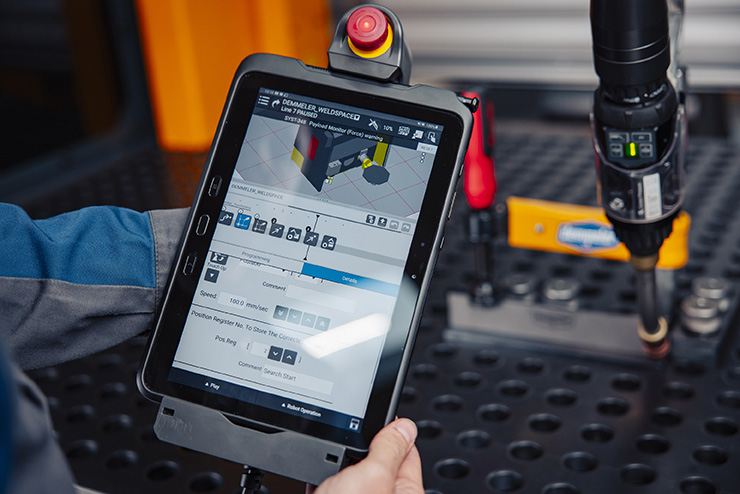
The F version uses the CRX-10iA robot and FANUC's familiar drag-and-drop technology.
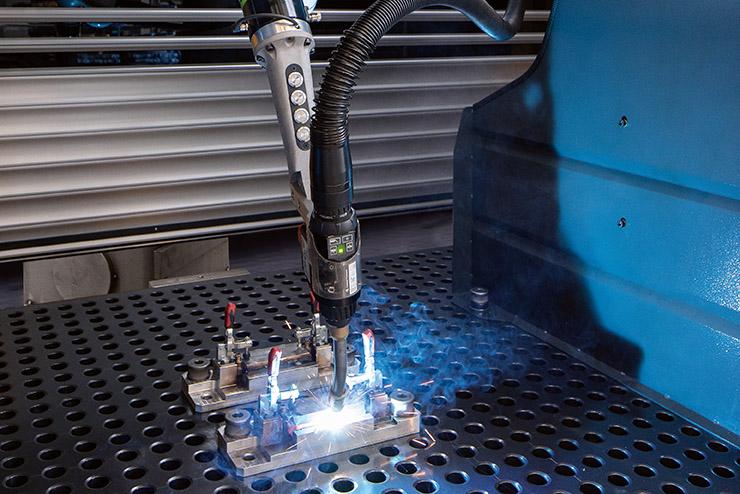
The multifunctional handle serves as an interface between the robot and the operator.