
12 November 2024
The focus remains on optimising the costs of welding processes. Shorter set-up and non-productive times are reflected in an increase in the degree of utilisation and automation. Choosing the right clamping devices and clamping systems is crucial for efficient manufacturing.
Welding efficiency is a complex issue and, due to high competition and price pressure, more relevant than ever. For welding tasks of all kinds, the main focus is on speed and potential savings without compromising on welding quality. In addition to numerous factors such as choosing the right filler material and the most suitable welding process, one of the most important questions is how to optimise work processes in order to make the best use of the most valuable resource: highly qualified welding specialists. On average, only 15 to 20 percent of the total manufacturing time for a welded structure is required for the welding itself. The rest is accounted for by set-up and non-productive times.
Good preparation is essential – this advice applies to all conceivable applications. It is also appropriate when it comes to welding. Clamping devices have a decisive influence on the cost-effectiveness of welding. Uniform and stable tension minimises deformation or stress in the material that can be caused by the welding process. Welded joints achieve high strength. This guarantees high-quality and secure welded joints. If the workpiece is not properly fixed, the effects of heat and tension during welding can lead to thermal deformation and distortion. The consequences are uneven weld seams, cracks and loss of stability. This means rejects or, ultimately, very time-consuming rework with unnecessary costs and delays. At the same time, precise clamping facilitates the alignment and positioning of the workpiece and compliance with the tightest tolerances. Smooth preparation increases productivity and reduces the overall duration of the welding process.
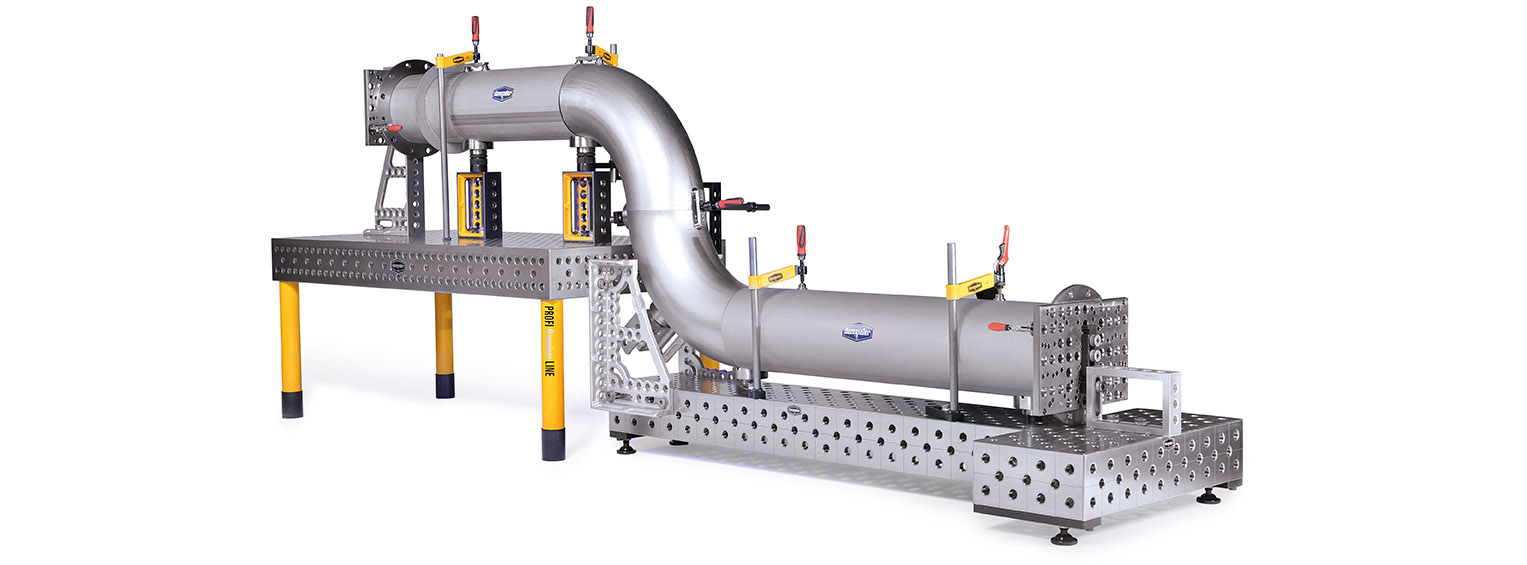
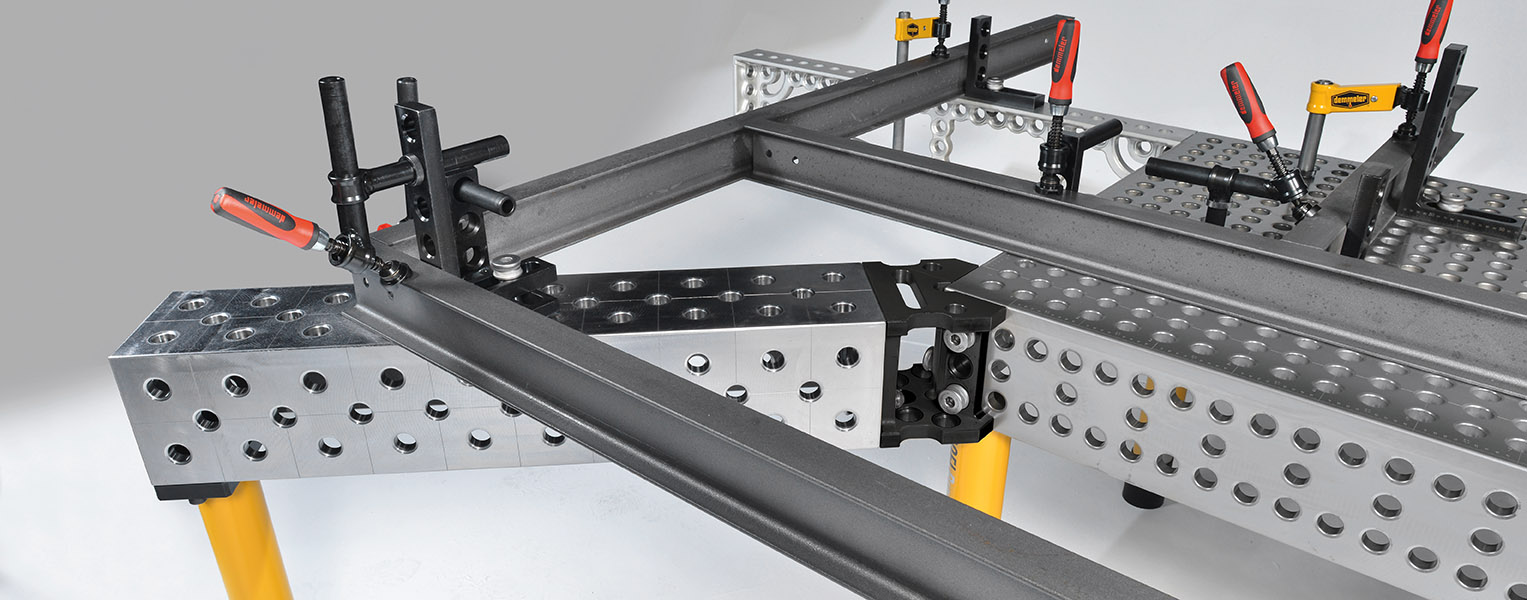
If the component does end up being larger, the working surface of the 3D welding table can be easily extended using the system parts.
Efficient clamping solutions: the system diversity of DEMMELER
DEMMELER's multifunctional tool can be combined in any way you like. This means that significantly less equipment is needed to clamp workpieces. This not only saves investment costs, but also storage capacity. DEMMELER welding tables are basically divided into the D28 system for large and heavy clamping and welding work, the D22 system for light and medium-duty applications, and the D16 system for small and light clamping and welding tasks. D28, D22 and D16 stand for the diameter of the system holes. In addition to the system size, various system grids are available: PROFIPremiumLINE, PROFIPlusLINE, PROFIEcoLINE and HobbyLINE. The density of the hole grid on the table top and the three-row hole pattern on the side rails greatly increase the expansion and clamping options of welding tables.
Over 1,000 clamping system items can be combined and expanded to create individual welding table systems: welding table tops, table legs, clamping bolts, angles, stops, supports, clamps, quick-release clamps and much more. The well-designed and intelligent accessories have some interesting features: DEMMELER screw clamps are designed with round tubes. This makes them extremely robust and allows maximum clamping forces to be achieved. The aluminium-titanium design of the stop angles enables optimum and very easy handling thanks to their low weight, and the 90° kidney-shaped system groove allows for continuous angle adjustment. The patented PPS clamping bolt allows the aluminium angles to be clamped without wear. The even distribution of force thanks to polygonal spreader elements prevents wear on the boreholes. Unlike square table feet, the round standard foot prevents snagging or bumping against the edges of the table foot. In addition, the integrated foot sleeve protects the hose package from jamming in the threaded spindle for fine adjustment.
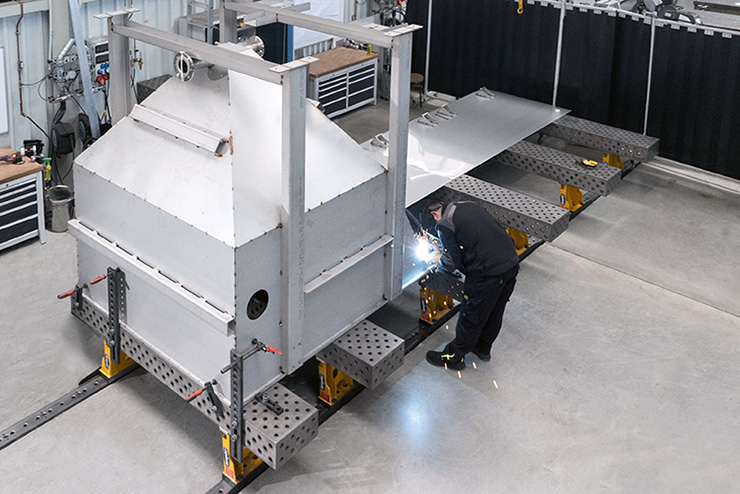
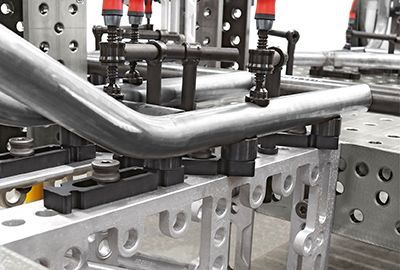
The 3D clamping system adapts to the size and shape of a wide variety of workpieces.
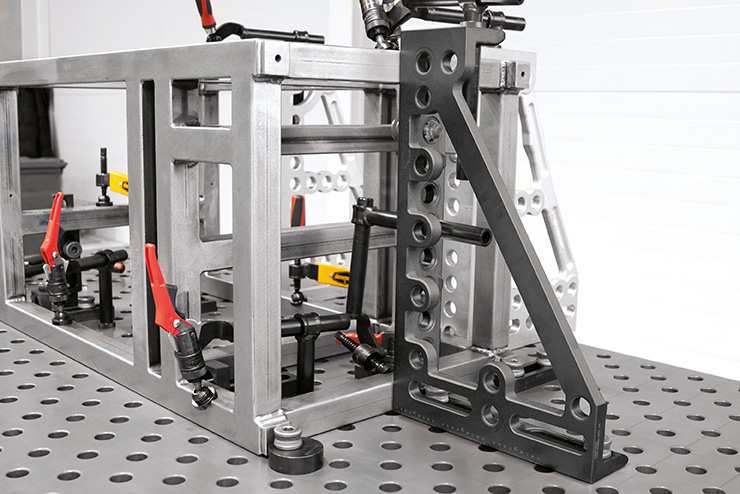
Thanks to its innovative design, a clamping device can be set up for almost any workpiece in record time.